
If you’ve been told you need laparoscopic surgery for fibroids or a hysterectomy, you may come across the term ‘morcellation’.
In this blog, we explain: what morcellation is; why it’s used; the different techniques available; and importantly, how modern surgical approaches (including manual, contained or ‘in-bag’ morcellation) are designed to maximise safety.
What Is Morcellation?
Morcellation simply means breaking a larger piece of tissue into smaller pieces so it can be removed through small incisions. (The word comes from old French ‘morsel’ or ‘morcel’, which meant ‘little bite.’)
In gynaecology, this is most commonly used during:
- Laparoscopic myomectomy (keyhole surgery to remove fibroids)
- Laparoscopic hysterectomy (keyhole surgery to remove the uterus)
Because laparoscopic (“keyhole”) surgery uses very small incisions, large fibroids or a bulky uterus cannot be removed in one piece through these small scars.
Morcellation allows surgeons to remove big things through small holes, thereby:
- Avoiding larger abdominal incisions, and enabling minimally-invasive surgery
- Reducing recovery time
- Minimising pain and post-operative complications (such as blood clots forming in your legs or lungs)
In fact, morcellation is one of the key techniques that makes laparoscopic surgery possible for larger fibroids!
Why Not Just Remove Everything Intact?
In some cases, removing the uterus or fibroid intact is possible: for example, if a ‘total’ hysterectomy is being performed, and the cervix and uterus can be brought out through the vagina, there is no need to perform morcellation.
However, this isn’t feasible when:
- The uterus is large, and doesn’t fit through the vagina
- A laparoscopic myomectomy is performed for fibroids > 1cm
- There is a large, solid ovarian cyst (eg. a fibroma)
Minimally invasive surgery has well-established benefits, including faster recovery, less pain, and shorter hospital stays. Morcellation is a technique that helps make these benefits accessible to more patients.
Types of Morcellation: not all techniques are the same
There are different ways to perform morcellation, and there are significant differences between these techniques.
Power vs. manual morcellation
Power morcellation (aka. ‘electro-mechanical’ morcellation) uses an electric device with a rotating blade to break tissue into smaller pieces inside the abdomen. Power morcellation is not performed by the gynaecologists in the Maven Centre team.
At Maven Centre, all gynaecologists perform manual morcellation. Imagine that the surgical specimen (eg. uterus, fibroid, ovary) is like an apple, floating free in your abdomen. We then bring the ‘apple’ up to the underside of your belly-button, and use a scalpel to ‘peel’ the ‘apple’ through your belly button. This is a slower, but more controlled, process than electro-mechanical morcellation. We end up with a long piece of ‘peel’ (anatomical specimen), which we send off to the laboratory for analysis by the pathology doctors.
Contained (‘in-bag’) vs. uncontained morcellation
Another key distinction when discussing morcellation is whether or not the surgical specimen (eg. uterus, fibroid, ovary) is placed into a bag before it is chopped up into little pieces.
When a bag is not used, it is referred to as ‘uncontained’ morcellation. Prior to a landmark medico-legal case in the USA in 2014, this was standard practice. When this landmark legal case occurred, concerns arose about the possibility of uncontained morcellation:
- Spreading undiagnosed cancer (particularly uterine sarcoma) throughout the abdomen
- Dispersing benign (non-cancerous) tissue within the abdominal cavity
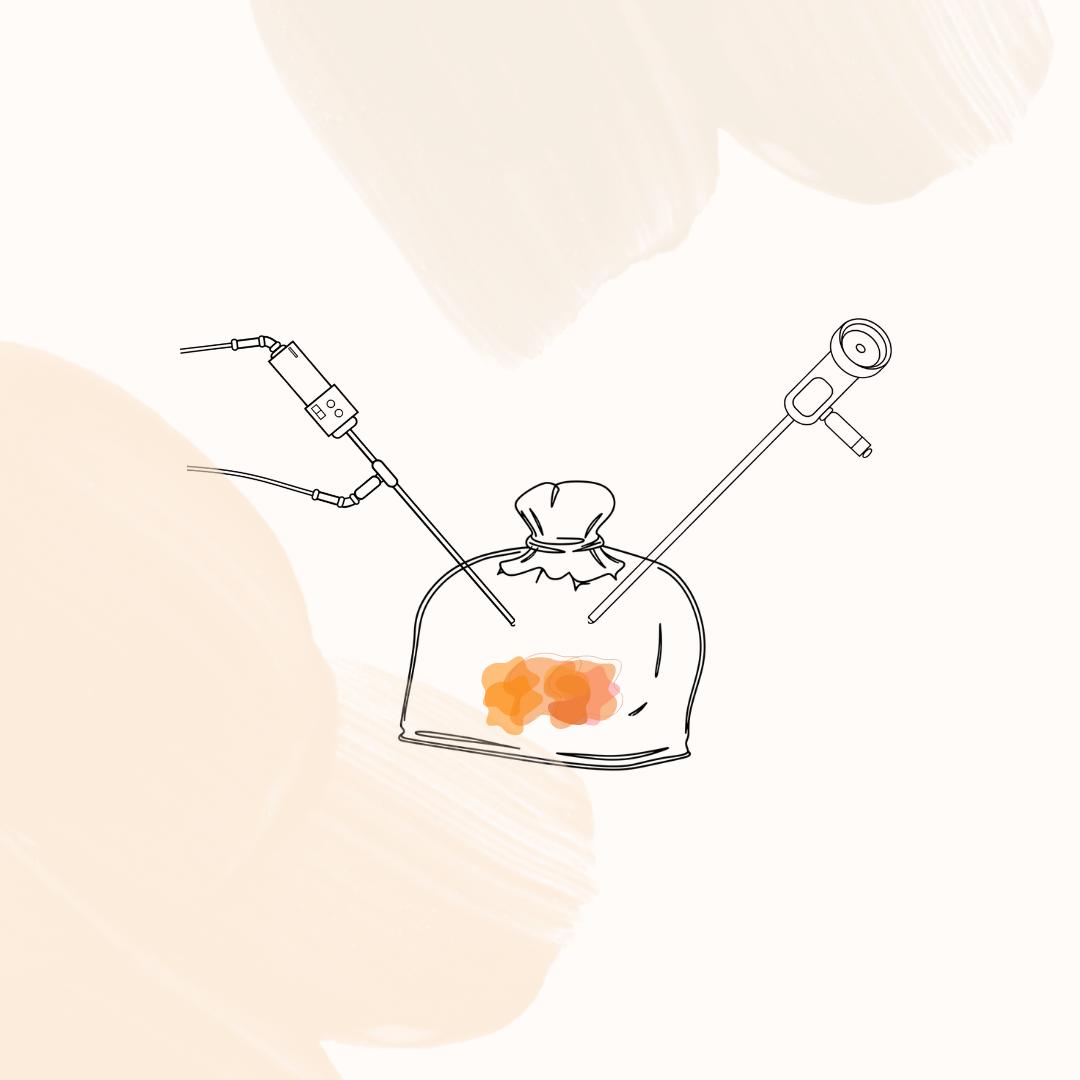
Since then, best surgical practice has evolved: morcellation should now always be performed in a ‘contained’ manner (ie. inside a bag). This involves:
- Separating the uterus / fibroids / ovary from surrounding tissue, so it’s floating freely inside the abdomen
- Inserting a specialised ‘containment bag’ into the abdomen through the bellybutton
- Placing the tissue inside a specialised containment bag, and bringing the bag up through the bellybutton: if viewed side-on, the bag would look like an hourglass, with the surgical specimen being in the bottom half of the hourglass (inside the abdomen), and the narrow part of the hourglass being at the bellybutton
- Carefully breaking the surgical specimen into smaller, bite-sized pieces (or ‘morsels’)
- Removing the containment bag, once it is empty – this means the entirety of the specimen has been removed
Such contained (or ‘in-bag’) techniques are designed to minimise any risk of tissue spread within the abdomen, and reflects current best-practice safety principles.
At Maven Centre, all gynaecologists who morcellate do so using a manual, contained (‘in-bag’) technique.
Why Has Morcellation Been Controversial?
The main concern relates to the rare possibility of an undiagnosed uterine cancer, such as leiomyosarcoma, being present at the time of surgery. If cancer is morcellated in an uncontained way (without using a containment bag), there is a risk that cancer cells could be spread within the abdomen.
It’s important to emphasise that:
- Uterine sarcoma is rare
- Pre-operative tests (such as MRI or serum lactate dehydrogenase) cannot always completely exclude malignancy
For this reason, careful surgical planning and technique are essential.
How Do We Minimise Risk?
Modern gynaecological practice focuses on risk reduction and informed decision-making.
Careful Patient Selection
Your doctor will assess for any features that may increase the risk of leiomyosarcoma, such as:
- Increasing age, esp. post-menopausal status
- Rapidly growing fibroids
- Specific findings on ultrasound, that raise concerns that a ‘fibroid’ may be suspicious
- Having had pelvic radiotherapy previously
Pre-operative Investigations
These may include:
- Pelvic ultrasound
- MRI (in selected cases)
- Endometrial biopsy (if indicated)
- A blood test called ‘lactate dehydrogenase’
Choosing a Safer Technique
At our practice, this means:
- Avoiding power morcellation
- Using manual, contained (‘in-bag’) morcellation in all cases
- Maintaining visual control throughout the procedure
Informed Consent
We believe it’s important that patients understand:
- Why morcellation may be recommended
- The benefits of minimally invasive surgery over open surgery
- The potential risks and alternatives
Are There Other Risks?
While uncommon, potential risks of morcellation include:
- Small fragments of tissue remaining in the abdomen
- Rare development of parasitic fibroids
- Endometriosis-like deposits
- Injury to surrounding structures (rare)
These risks are reduced with careful technique and use of containment systems.
What Are the Alternatives?
Depending on your situation, alternatives may include:
- Mini-laparotomy (a slightly larger incision, up to 5cm in diameter)
- Removing tissue intact through an even larger abdominal incision (> 5cm)
- Vaginal removal (if feasible)
Each approach has advantages and trade-offs, and the best option depends on your individual situation.
What Does This Mean for You?
If you are considering laparoscopic surgery, it’s reasonable to ask:
- Will morcellation be needed?
- If so, what technique will be used? (Mechanical or manual; contained or uncontained)
- What are the alternatives?
At Maven Centre, we prioritise:
- Careful pre-operative assessment
- Clear and transparent discussions
- Minimally invasive surgery where it is safe to do so
- Manual (not power) morcellation
- Contained (‘in-bag’) techniques
The Take-Home Message
Morcellation is an important technique that allows large anatomical specimens (eg. uterus, fibroids, ovaries) to be removed through small incisions, making minimally invasive surgery possible for many women.
While concerns have been raised about certain methods, modern approaches focus on safer techniques, such as manual, contained morcellation.
When performed thoughtfully and by experienced surgeons (such as Maven Centre’s Dr Sneha Parghi and Dr Alison Bryant-Smith), this approach allows patients to benefit from faster recovery, smaller incisions, and excellent surgical outcomes.
Final Word
If you have questions about morcellation or are planning surgery, we encourage you to discuss this with your gynaecologist. Understanding the technique (and the safeguards in place) can help you feel confident and informed about your care.